Please stop by for these upcoming events:

Conversations with gallery artists at
Susan Maasch Fine Art, 567 Congress Street, Portland, Maine, Thursday December 2, 2010, 6:30-8:30PM
Participating Artists:
Anne Ireland, Tom Butler, Kate Russo, Jemma Gascoine, Elizabeth Jabar, Clint Fulkerson, and Jan Pieter Van Voorst Van Beest

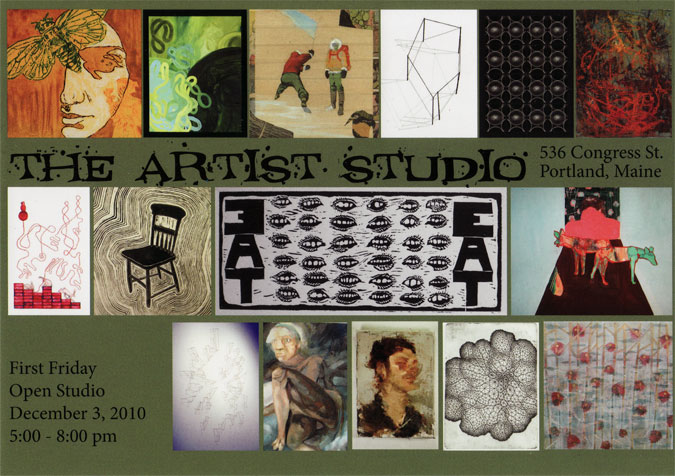
Open Studios at
The Artist Studio, 536 Congress Street, Portland, Maine, Friday December 3, 2010, 5-8PM
Participating Artists:
Greg Day, Kelly McConnell, John Knight, Lisa Pixley, Tina Purves, Sage Lewis, Joe Begnaud, Christopher Campbell, Lucinda Bliss, Stephen Benenson, Tim Clorius, Tim Keeshen, Roz Gross, Annie Larmon, Clint Fulkerson,
Pickwick Independent Press, Cat Jensen, Jenny McGee Dougherty, Edwige Charlot, Kim Convery, Hilary Irons, Shoshannah White, Sean Newton, Kate Cleaves, Martha Miller, Carol Morrissette, Kevin Moquin, Elizabeth Chapman, Catherine Lo, Greta Bank, Jim Lynch, Kris Johnsen, Timothy Wilson, Joshua Loring, Edie Ware, Sean O'Brien, Devin Dobrowolski, Maria Wolf, Michelle Livingston
 If you're in Portland tomorrow for the First Friday Art Walk, stop by Space Gallery at 538 Congress Street for the opening for Polyhedra. I did this big-ass wall drawing and I have 2 paintings in the show as well. Also during the art walk, there's an exhibit of Rackstraw Downes' work at the Portland Museum of Art and Daniel Meiklejohn's work at Fore River Gallery.